I’ve been using Rob Miller’s Now Reading plugin to show a list of books I’m currently reading in my blog’s sidebar, as you can see. The plugin allows you to show sublists of books you’re reading, books you’ve read, and books you’re planning to read. However, I wanted more, so I’ve done some hacking. What I’ve added is:
- a new category, ‘Favorite books’;
- an option to display only the category/categories you want;
- a text field for each book to store and later display your own review.
Continue Reading »
About eight or nine years ago, I first read about Java in Wired Magazine. At the time, I was mostly programming in Delphi, C, and, if I really had to, in Oracle Forms. It wasn’t altogether clear what role Java was going to play; any examples you ever saw were applets, doing image animations on a web page. I bought a book that promised to explain it all, but did little else but list the standard libraries api docs. Although over time, more and more people were saying Java was going to be the next great thing, I didn’t have a clue what to do with Java, there & then. (Until 2000, when I did my first web app with Java, with EJB’s, and started wondering why I had ever wanted to be a part of this next great thing).
Right now I’m having a strong feeling of deja vu. This time, it’s about Ruby. Everyone probably knows by now that Ruby is a scripting language, developed nine years ago in Japan, became very popular in the rest of the world in the last year or so. Recurring discussions on TSS revolve around the question if and when Ruby is to be preferred over Java, and if it will be the next great thing. Surely the language looks interesting enough, and so does the web framework, Rails. But in order to really get to know it, I have to use it in a real project, doing real stuff (I have not enough patience or spare time to just code something for the sake of it).
There’s several books written about Ruby, of which Programming Ruby comes recommended by Remco, my local Ruby guru (and by none other than Martin Fowler, I read at Amazon). Until now, I’ve done it the cheap way by reading Why’s (Poignant) Guide to Ruby. This free ebook explains the basics of the language in the form of a rather insane story, illustrated with equally wacko comic strips. It tries to offer memory aids through its story for Ruby’s language features. Unfortunately, most of these memory aids are so far-fetched that I’m having trouble remembering _them,_ let alone the language elements they’re supposed to remind me of. But it does make for entertaining reading, offering an easy introducting to Ruby.

We loved the food and wine in Ljubljana. Since we were in a hotel, we had to eat out all the time; which I don’t complain about, but it’s always nice to do some cooking yourself in another country, to get a better feel for the ingredients and recipes there. From the Lonely Planet site, I got the impression that horse meat is very popular in Slovenia. And indeed, most restaurants serve one or two dishes with horse in them. We never ate that though, don’t know why, it’s just not done where I come from. Still, there were enough alternatives to choose from. A lot of meat, game, saucages; fish now and then; but also enough vegetable-based dishes (I’m not vegetarian, but I love to eat veggies). There’s quite a number of Italian restaurants, serving pasta dishes, gnocchi, risotto; and again, meat.
And the wine! Great wine all around; very young red wine that we drank at lunch in Luka Gourmet’s Lunch Café; fresh and fruity white and sparkling wines; and more aged reds, it was all there, all Slovene. Someone told us Slovenia doesn’t produce enough wine to export, so it will be hard finding any abroad. And as we travelled by train, we couldn’t take any with us. Another reason to come back some time, by car.
The restaurants we liked most:
- Sokol, serves Slovene dishes; I had a big plate with all sorts of saucages, as well as the braised cabbage we often got; a bit like sauerkraut, but less sour. Nice young house wine served at the right temperature: cold.
- Luka Gourmet’s Lunch Café is an Italian restaurant, always crowded at lunch time, though we always managed to find a table. Good simple pasta dishes, but they also have a daily changing menu that will bring some variation when you’ve got to know the regular menu, when you come there rather often. As we did. Their young house wine comes from a tap, and I could drink this every day. As we did.
- Špajza has a large choice of Slovene and Italian dishes as well as an extensive wine list. We ate there on our last evening in Ljubljana, and a good choice that was. We loved the venison with berries (maybe a bit too hefty for the Merlot).
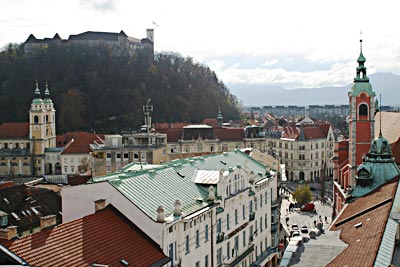
Finally the gray blanket over Ljubljana has lifted and we’re seeing some sun today for the first time, our last day in the Slovene capital. Yesterday, we visited the school museum; a tiny little museum in an old school building. We were asked to join a Slovene school class in a ‘lesson from the past’, a writing lesson as it would have been given in 1930. A very strict teacher first checked everyone’s hands to see if they were clean, then proceeded to teach how to write different letters–with old fashioned ink and pen. It was all fun to watch, even though we didn’t understand a word (it was all in Slovene).
In the evening, we were invited to the home of M.’s Slovene colleague for dinner. It’s strange how you expect everything to be different in another country, when so much turns out to be so recognizable and familiar. That’s something to realize when you read about faraway countries: people there work, and eat, and have children, and enjoy themselves, just like people do in your own environment. Another very pleasant evening.
Tomorrow we’re off on an excursion touring the country, so we’ll see some more of Slovenia outside its capital. And after that we’re on the train back home…